Collection · PL
China - Xinjiang textile emergency currency on red cloth (1880-1924): decentralization under stres
These seven textile notes form a single, continuous teaching set from Xinjiang (historically spelled Sinkiang) spanning late Qing frontier administration through the early Republican period (1880-1924). They are not presented as seven isolated curiosities. Taken together, they document a recurring frontier solution to the same problem: how to keep money functioning when coin is scarce, paper supply is constrained, transport is unreliable, and authority is fragmented.
In most places, banknotes are a paper story. In Xinjiang, there is also a cloth story. Contemporary and later descriptions of the region's "oil-cloth notes" (often described as cloth treated with an oil or preservative) make the logic brutally practical: cloth is locally available, tough, and circulates well in harsh conditions, but it also creates new weaknesses (ink adhesion, tearing, alteration, counterfeiting). This Spotlight uses a seven-piece sequence to explain that entire logic as a system, not as a one-off anomaly.
At a glance
- Region: Xinjiang (Sinkiang), with administrative references to Dihua (Tihua) and South Xinjiang frontier jurisdictions.
- Material: red-dyed textile (cloth) used as a monetary substrate; printed by hand (woodblock) with official framing elements and control marks.
- Units: copper-cash accounting (wen / red cash references) and a higher-value accounting unit (tael) used in military or wholesale settlement contexts.
- Languages: Chinese plus regional Turkic script forms on multiple pieces, matching how money had to be legible across a mixed commercial and administrative environment.
- Why it matters: a seven-note chain across 44 years is strong evidence of a repeated policy-and-logistics solution, not a single emergency improvisation.
The core question: why cloth at all?
If you approach these as "primitive banknotes," you miss the point. Cloth here is not symbolic. It is a frontier logistics choice. Late Qing and later references describe Xinjiang cloth notes as being printed on cloth treated with oil or a preservative: durable in circulation, but problematic for ink absorption and therefore vulnerable to alteration and counterfeiting. That tradeoff is exactly what you would expect from an emergency medium selected for endurance rather than print elegance.
Chinese descriptions of late Qing Xinjiang note production explicitly tie this to technique: printing on oil-cloth (described as "oil-cloth printing") and coating with tung oil to preserve the print. Whether every local issue followed the same recipe or whether multiple workshops adapted the idea, the shared logic remains consistent: make something that survives handling, humidity, travel, and storage when regular paper supply and modern presses are not the bottleneck you can solve.
The second question: who had the authority to issue it?
This seven-note chain matters because it is not one issuer. It spans at least three authority modes:
- Local civil or regional authority issues (frontier circulation substitutes without the formatting of modern banknote systems).
- Military command issues (explicitly tied to provisioning, control, and settlement within a defended frontier zone).
- Official bureau issues (Dihua / Tihua bureau context, with denominational language in the copper-cash accounting universe).
The point is not to force all seven into a single bureaucratic template. The point is to show continuity of method across changing political conditions: a recurring frontier technique that multiple authorities could adopt when standard money could not do the job.
The third question: how did denomination work on the frontier?
Xinjiang monetary life had to reconcile at least two accounting worlds: copper-cash language (wen, and "red cash" references in later descriptions) for everyday settlement, and silver-weight accounting (tael) for larger settlement, military supply, and inter-institution transactions. That split is not theoretical. It is visible in this set: one piece denominated in taels sits alongside multiple cloth issues expressed in the smaller cash universe.
For a collector, it is tempting to read tael vs cash as merely "a bigger note." For a historian, it signals something more specific: the issuer expected certain users to settle in bullion-equivalent accounting, not only in day-to-day market cash. That is a clue to function, not just value.
What this seven-note chain demonstrates (1880-1924)
If you only knew one institutional example (a single year, a single bureau), you might interpret Xinjiang cloth notes as an isolated emergency. A seven-note chain changes the historical burden of proof in the opposite direction: the default interpretation becomes continuity. These are different designs, different authority signals, and evolving visual vocabulary, but one recurring technical answer: cloth as money under frontier constraint.
| Year | Issuer / Type | Unit | Why it matters in the chain |
|---|---|---|---|
| 1880 | Sinkiang textile emergency currency (frontier tradition) | Local | Earliest anchor: shows cloth-money logic present before later, better-described bureau structures. |
| 1915 | South Sinkiang Border Defence HQ textile issue | 1 Tael | Military authority + higher accounting unit: points to provisioning and controlled settlement. |
| 1918 | Xinjiang local textile issue (woodblock) | Unspecified | Confirms continued local issuance after 1915; design vocabulary shifts but substrate logic stays. |
| 1920 | Xinjiang local textile issue (woodblock) | Unspecified | Shows the practice is not a single-year emergency: it is a repeating frontier tool. |
| 1921 | Xinjiang local textile issue with sun emblem (woodblock) | Unspecified | Republic-era visual vocabulary enters the frontier cloth-note tradition without modernizing the production method. |
| 1922 | Xinjiang local textile issue (woodblock) | Unspecified | A late-stage local issue just before the 1924 official-bureau piece in this set. |
| 1924 | Dihua Official Coin Bureau textile emergency issue | 40 Wen | Official bureau framing: cloth not as folk money, but as a formal response inside an administrative system. |
How to read cloth money like a historian (not like a catalog)
- Material choice is policy. Paper vs cloth is not aesthetics. It is a supply chain decision.
- Ink behavior is evidence. Uneven saturation on cloth is not automatically "bad printing" - it can be the expected result of preservative-treated textile and woodblock strike variation.
- Overprints are control. Heavy red chops and overprints are not decoration; they are validation and circulation control in a weak-security medium.
- Bilingual text is functionality. On a frontier, legibility is part of monetary acceptance.
- Denomination units reveal intended use. Tael language points toward higher-level settlement; cash language points toward everyday circulation and local accounting.
The seven notes (images and object links)


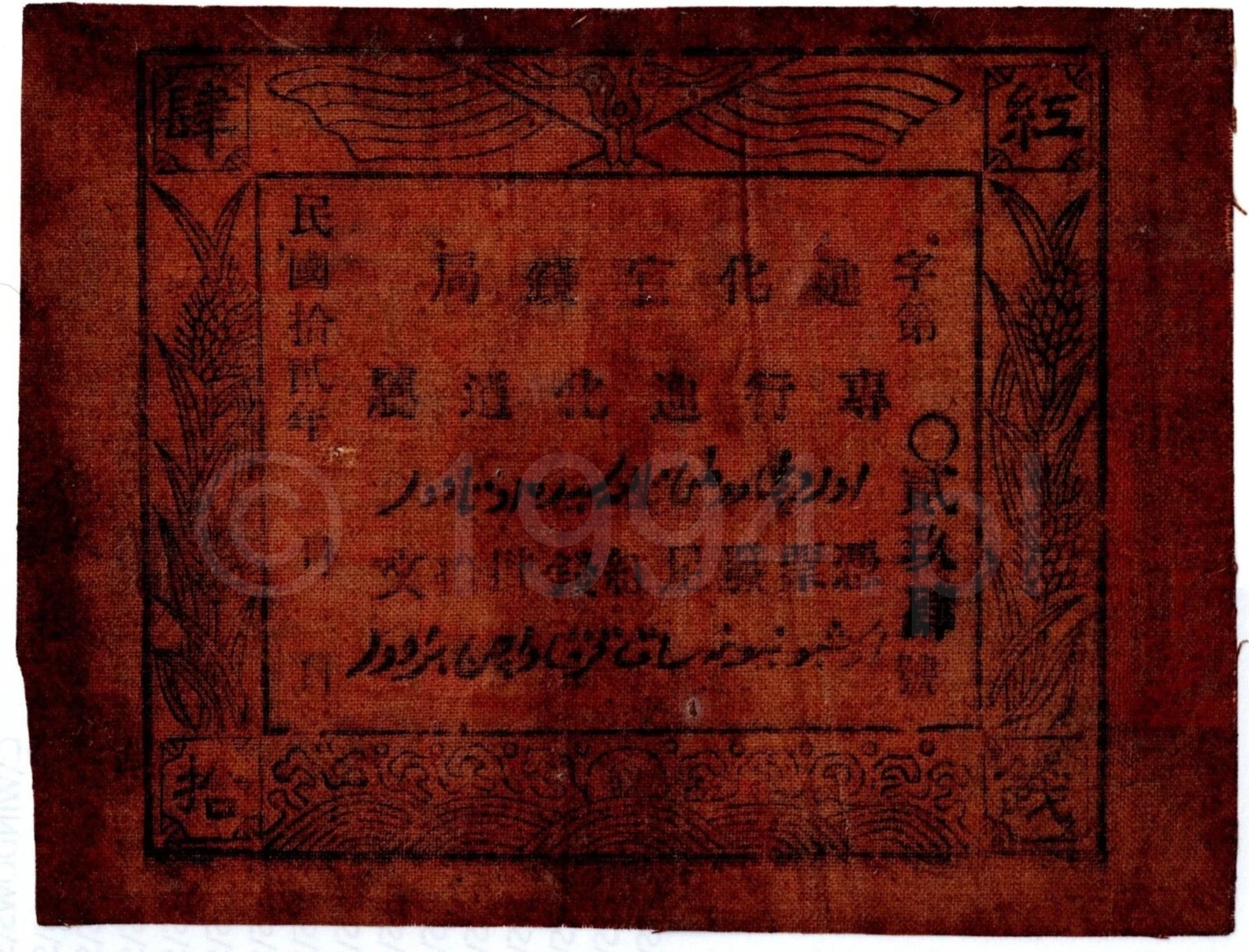

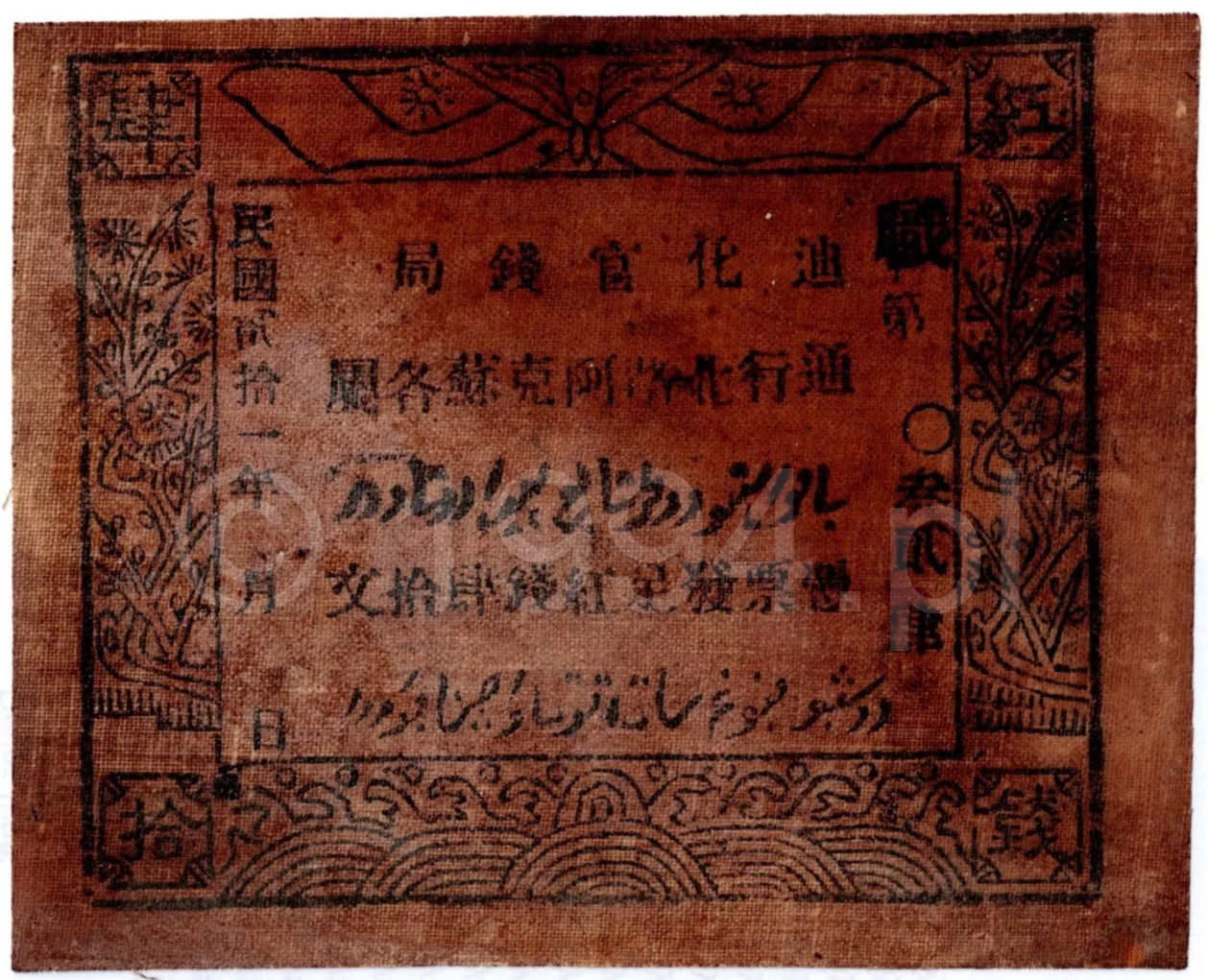
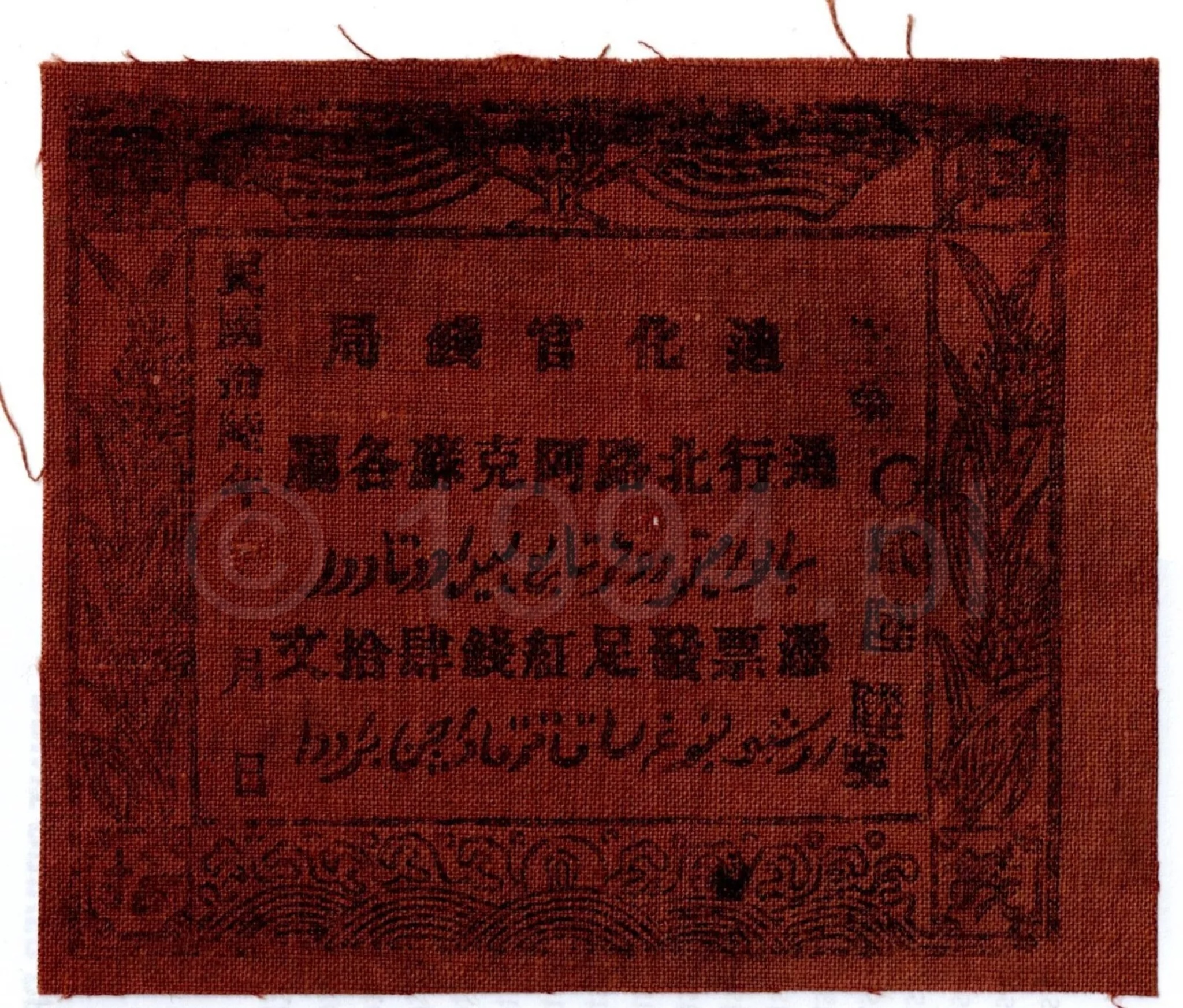

What the sources say about Xinjiang cloth notes (and why this set is different)
The published record on Xinjiang cloth notes is thin compared to mainstream Chinese banknote literature. Where it does appear, it is usually as a short note: "printed on cloth treated with oil/preservative," durable but hard to print cleanly, easy to alter, frequently counterfeited. That is exactly why a seven-piece chain matters. Instead of a footnote, it becomes a case study: one method, multiple authorities, evolving iconography, and a long operational lifespan.
Another point that matters for interpretation: the cloth-note technique is not necessarily an isolated dead end. At least one older English-language reference explicitly suggests that experience printing on cloth in Xinjiang was later utilized by other Chinese printing establishments. That turns this from a regional oddity into a technical ancestor worth taking seriously.
Research questions this chain forces us to answer
- When did the cloth-note practice start locally? This chain begins at 1880, earlier than many short secondary descriptions that focus on later bureau issuance.
- Which authorities used cloth for which channels? Military provisioning and bureau-issued small-denomination circulation are not the same use-case.
- Was oil/preservative treatment universal? Some descriptions imply "oil cloth" as a defined method; local issues may have varied by workshop and circumstance.
- Why red cloth so often? Visibility, dye availability, regional convention, and deterrence are all plausible and should be tested against additional material.
- How did bilingual legibility shape acceptance? Later Xinjiang issues are known to use Chinese and regional scripts; this chain shows that bilingual reality earlier in the textile tradition.
- How were these redeemed or retired? Cloth money is easy to issue and hard to withdraw cleanly without administrative reach. That tension is a frontier signature.
This Spotlight is intentionally written as a foundation. The seven objects are the evidence. The job of the text is to explain the system these objects imply, and to place that system inside the known constraints of Xinjiang frontier administration and monetary logistics.
References and further reading (external links)
- UNESCO - The fabric of banknotes: textiles in and on paper money
- Ward (1970) - Chinese Banknotes (full text at archive.org)
- Baike - Xinjiang guanqianju (official money bureau) overview
- Late Qing Xinjiang paper money overview (Chinese) - mentions oil-cloth printing and tung oil treatment
- Auction reference (Chinese) - Dihua official bureau cloth currency with "40 wen" wording (1924 context)
- Heritage Auctions reference - later Xinjiang emergency notes showing Chinese and Uyghur script (context for bilingual frontier money)